AEO & GEO: How to Get Your Business Cited by ChatGPT, Gemini & Perplexity
SEO gets you ranked, AEO gets you chosen as the direct answer, and GEO gets you mentioned and cited by AI assistants like ChatGPT, Gemini and Perplexity. All three reward the same things: pages machines can actually read, clear answers to real questions, structured data that says who you are, and a consistent reputation across the web.
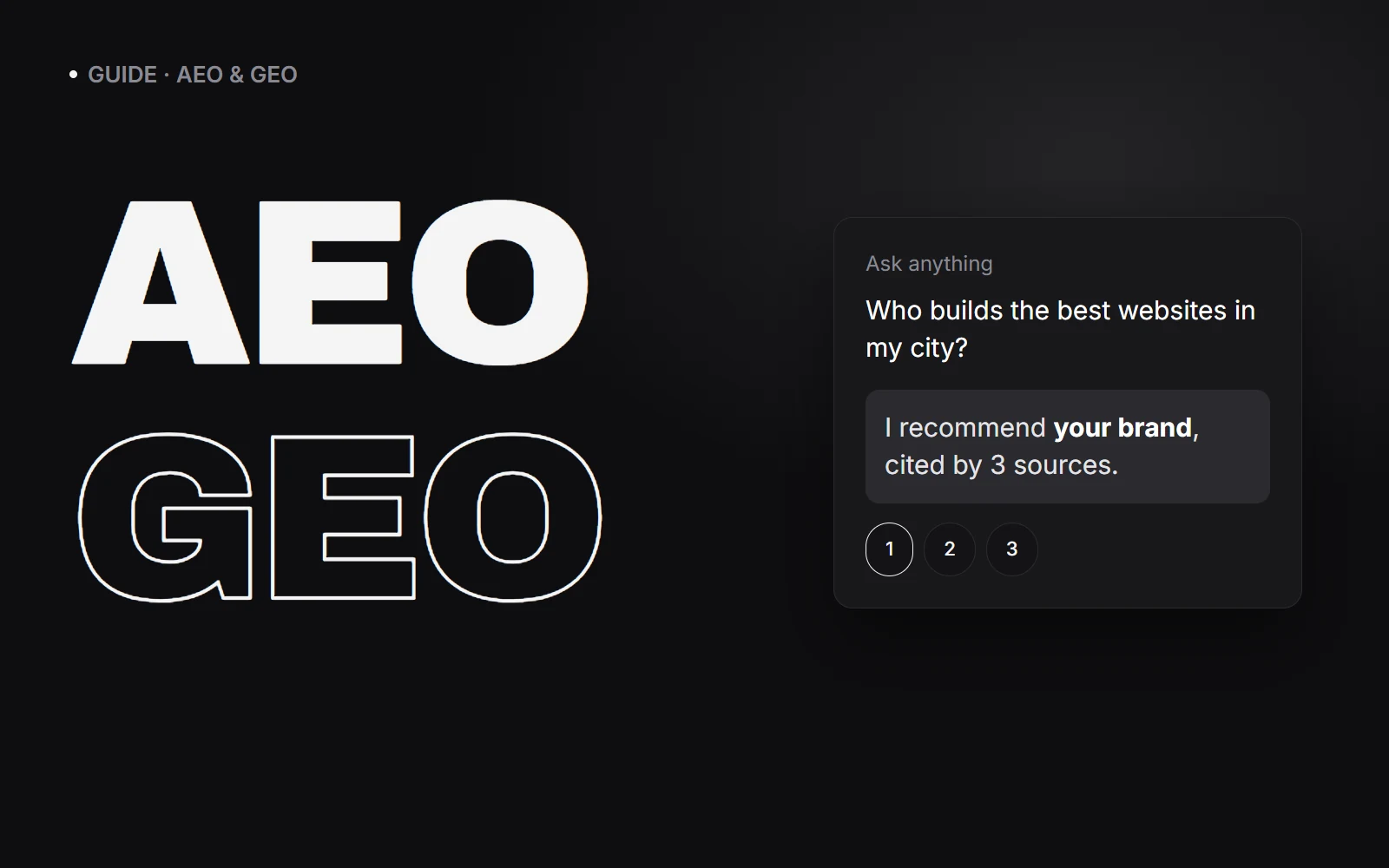
What are AEO and GEO?
Search used to mean ten blue links. Today a growing share of questions are answered before anyone clicks: in Google’s AI Overviews and featured snippets, in voice assistants, and in chat tools like ChatGPT, Gemini, Claude and Perplexity.
Answer Engine Optimization (AEO) is the practice of shaping your content so it gets picked as that direct answer. Generative Engine Optimization (GEO) goes one step further: making your brand more likely to be named, recommended and linked when an AI assistant writes its reply.
Neither replaces SEO. They sit on top of it. An AI assistant can only cite pages it can find and read, so the technical foundations of SEO matter more than ever.
How do AI assistants decide who to cite?
When an assistant searches the web to answer a question, it pulls a handful of pages, reads them and writes a summary, often with links to its sources. The pages that win tend to have three things in common:
- They are readable: the content is in the HTML the crawler receives, not hidden behind JavaScript, logins or pop-ups.
- They answer the question plainly, near the top, in words that match how people ask it.
- They look trustworthy: a clear author or business behind them, consistent details across the web, and evidence such as reviews, case studies and real numbers.
Step 1: Make sure AI crawlers can read your site
- Serve real HTML. Use server rendering or pre-rendering so every page’s text, headings and links are in the initial response.
- Allow the crawlers in robots.txt: Googlebot and Bingbot, plus AI crawlers such as GPTBot, OAI-SearchBot, ClaudeBot, PerplexityBot and Google-Extended, unless you have a reason to block them.
- Publish a sitemap.xml with accurate last-modified dates, and submit it in Google Search Console and Bing Webmaster Tools.
- Keep pages fast and mobile-friendly. Slow, heavy pages get crawled less.
- Optionally add an llms.txt file: a plain-text summary of who you are and your key pages. It is an emerging convention, not a guarantee, but it is cheap to add.
Step 2: Answer questions directly
Write for the question, not the keyword. Look at what customers actually ask on calls, in emails and in reviews, and give each important question a clear home.
- Start pages and sections with a two- or three-sentence answer, then go into detail.
- Use question-shaped headings (“How much does a website cost?”) so the answer is easy to lift.
- Add an FAQ to service and product pages, with short, specific answers.
- Use specific numbers with context: “40% more customers after online booking launched” beats “great results”.
- Use lists and comparison tables. Assistants love structured, scannable content.
Step 3: Tell machines who you are with structured data
Structured data (schema.org JSON-LD) is a small block of code that states facts about a page in a machine-readable way. It removes guesswork about who you are and what you offer.
- Organization or Person for the business or founder, with sameAs links to your real profiles.
- LocalBusiness with your address, hours and phone if you serve a local area.
- Service or Product for what you sell, and FAQPage for your questions and answers.
- Article or BlogPosting for guides, with an author and dates.
Keep your name, address and phone exactly the same on your site, Google Business Profile and directories. Consistency is a trust signal for both search engines and AI models.
Step 4: Build the signals AI trusts
- Get mentioned on other credible sites: local press, industry directories, partner websites, podcasts.
- Collect reviews on Google and reply to them. Assistants often summarise review sentiment.
- Publish case studies with real results, and an author page that shows who is behind the work.
- Keep key pages current and show the updated date. Stale facts get replaced by fresher sources.
Step 5: Measure what is working
- Once a month, ask ChatGPT, Gemini, Perplexity and Google the questions your customers ask, and note whether you are mentioned and which pages are cited.
- In Google Analytics, watch referral traffic from chatgpt.com, perplexity.ai, gemini.google.com and copilot.microsoft.com.
- Use Google Search Console for Google: traffic from its AI features is reported within regular search performance.
A quick AEO & GEO checklist
- Every page’s content is in the HTML (pre-rendered or server-rendered).
- robots.txt allows search and AI crawlers; sitemap.xml is live and submitted.
- Each key page opens with a short, direct answer.
- Service pages have FAQs; headings are phrased as questions.
- JSON-LD for your organisation, services, FAQs and articles.
- Consistent business details everywhere; Google Business Profile complete.
- Case studies with real numbers and an author page.
- Monthly check of what AI assistants say about you.
Frequently asked questions
Is GEO replacing SEO?
No. AI assistants rely on search indexes and crawlable pages, so SEO is the foundation that AEO and GEO build on. Think of them as one visibility strategy with three layers.
Do I need an llms.txt file?
It is optional. llms.txt is an emerging convention that gives AI tools a plain-text summary of your site. It is quick to add, but readable HTML and good content matter far more.
How long does it take to get cited by AI assistants?
Technical fixes such as pre-rendering and structured data can be picked up within weeks of being crawled. Earning mentions and trust is ongoing, usually showing results over a few months.
Can a small local business get mentioned by ChatGPT?
Yes. For local questions, assistants lean on Google Business Profile data, reviews and clear local pages. A small business with consistent details, good reviews and direct answers can outrank bigger competitors.